There is a common misconception that eating disorders somehow disappear during pregnancy; that becoming a mother stops all those silly worries about being slim and attractive. This is not necessarily the case, and unfortunately, there is a lot of stigma associated with talking about disordered eating behaviours during pregnancy. Openly admitting to it is an invitation, it seems, to being called selfish and vain. The implication is that eating disorders are something only young girls struggle with, and that pregnancy and motherhood are such big and important things that they should be enough to overcome an eating disorder.
Over recent decades, eating disorders have entered the public’s consciousness. They are regularly discussed, and often trivialized, in the popular media, depicted as no more than dieting gone wrong or overzealous weight loss. Yet these conditions warrant serious consideration because they are potentially life-threatening and can persist for years, ruining individuals’ long-term health, their personal and their social functioning.
In a large population-based study of 12,254 pregnant women in the UK, over 4% of women experienced past or present eating disorders (Micali et al., 2007). In this study, Tierney and colleagues wanted to find out how those women with present or past eating disorders experienced pregnancy and early motherhood.
They interviewed eight women between the ages of 17 to 37 about their experiences during pregnancy and (if applicable) motherhood. Some women were expecting their first child while others already had three. Five out of eight women were interviewed post pregnancy (from 2 months to 24 months post pregnancy). All had an eating disorder prior to becoming pregnant. All except one developed their eating disorder during their teens (one developed AN after the birth of her second child).
The authors identified four sub-themes which fell under a major theme of divided loyalties between putting their child first and heeding to their eating disorder:
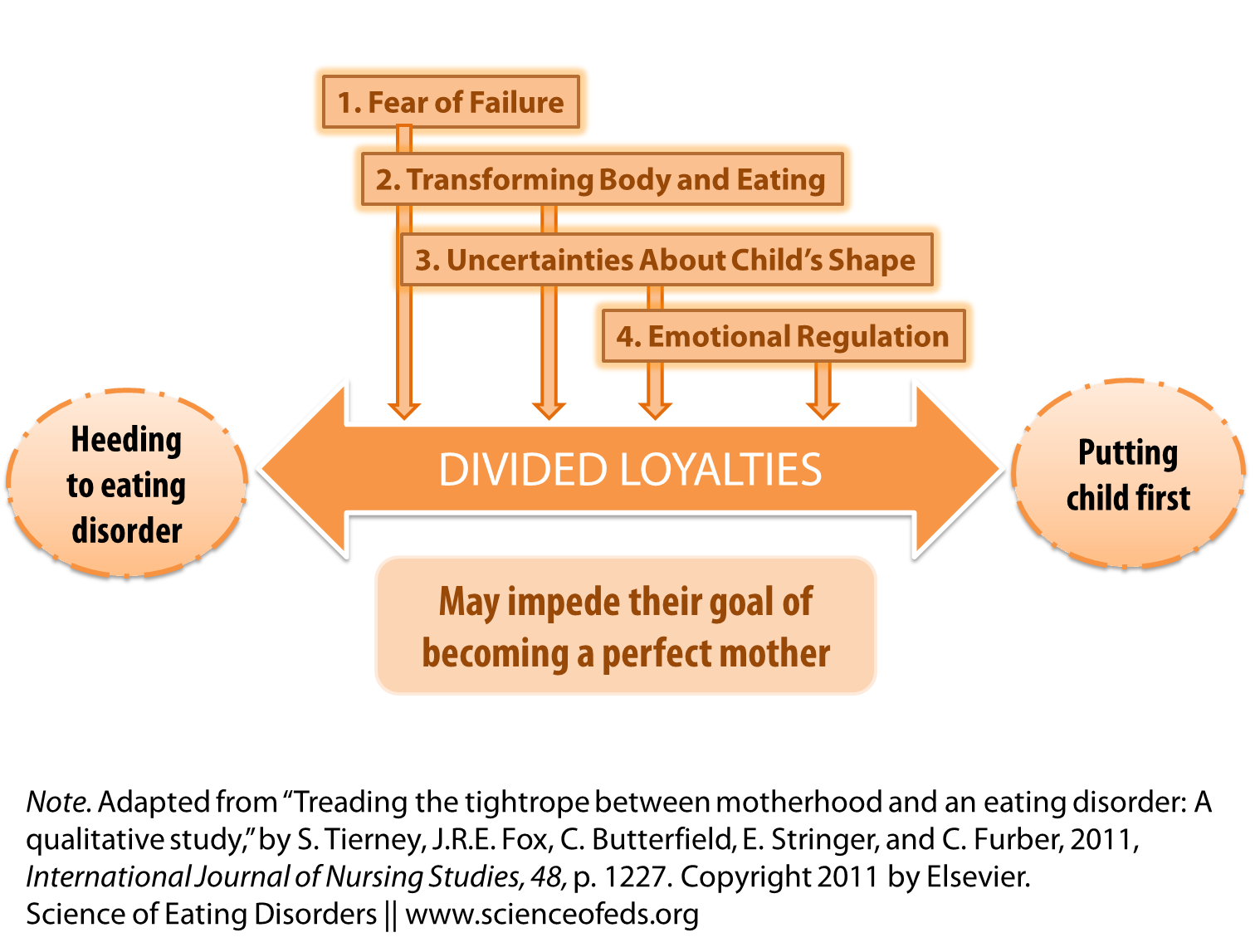
THEME 1: FEAR OF FAILURE
Breast-feeding was a common area where mothers felt inadequate:
I really, really wanted to be able to eat more in order to produce better milk and I couldn’t do it and I felt that I’d failed him. I can remember crying when I was buying the formula for the first time and I couldn’t. . .be around when he was given the formula because it upset me. . .I didn’t want anyone else to know he was getting the formula.
Many women were not open with their partners about their eating disorder behaviours (such as purging) because they felt that they were letting down their spouses. Some participants avoided socializing with other mothers because they were uncomfortable talking about weight gain/gain.
Participants were also worried about how others would judge them, fearing others would not understand their compulsive need to engage in behaviours as a coping mechanism.
I think people who haven’t experienced it can be very judgemental of someone who’s pregnant and can’t eat properly. I took part in an article for [newspaper] last year about eating disorders in pregnancy and although I had a lot of very positive feedback and supportive comments from my family and friends, over the internet there were a lot of really nasty comments about it posted on the website ‘these selfish women, they shouldn’t have children’, things like that. . . if you haven’t got that experience then it seems, it just seems like you are putting your appearance above your child’s health and that’s how it must seem to people I think.
THEME 2: TRANSFORMING BODY AND EATING BEHAVIOURS
Interviewees varied in how they felt about their changing bodies. Some hated it because they were at their heaviest, whereas others were fine with it after it became obvious that they were pregnant (and not “getting fat”.)
Some loved their baby bumps. One participant said it was the happiest she had ever been with her body, “valuing its productiveness.”
Many participants said they felt that their food intake was closely monitored by their partners, at work, or by professionals. Many struggled to eat an adequate amount of food and put on sufficient weight. One participant continued to eat small portions of low fat food and exercise rigorously. Some, however, were able to overcome their anxieties.
A craving for fish and dairy products caused participant 8 to eat these foods when pregnant, even though she had refused to consume them for five years. She recalled how doing this got easier the bigger she became during the pregnancy.
THEME 3: UNCERTAINTIES ABOUT CHILD’S SHAPE
Participants worried about their child becoming obsessed with food, but they also worried about their child becoming obese. As a result, the women tried to hide their own anxieties about food and weight, and attempted to eat as a family, even though this often increased their anxiety levels.
The preceding description of data implies that women with an eating disorder may see their child’s shape as an external marker of their success as a parent. Recent social messages about obesity in childhood could increase anxieties about an offspring’s weight and the need to monitor this closely. As noted above, a desire for control and striving for perfection have been associated with eating disorder onset and could extend to food consumed by children; some women with an eating disorder may see their child’s body as an extension of their own, viewing any changes in their offspring and his/her eating behaviours as indicative of their own self-control, potentially projecting their condition onto the youngster as a consequence.
(I’m really curious if other mothers relate to this?)
THEME 4: EMOTIONAL REGULATION
Eating disorders are a powerful way to modulate (or suppress) emotions. Women in this study struggled with anxiety and depression through-out their lives, and some admitted to suicide attempts in the past. Unfortunately, low moods persisted for some during pregnancy and/or after giving birth.
Many women reported using exercise as a way to regulate negative emotions during pregnancy, but others relied on their eating disorders.
As well as exercise, a number of interviewees talked about inducing vomiting whilst pregnant to regulate emotions. They felt some guilt about how it might affect the child but also depicted this behaviour as compulsive, adding that it brought them relief. Participant 7, in particular, noted how hard it was to refrain from doing so in pregnancy because negative feelings (e.g. of greed and being weak) encountered after eating were so powerful and only abated once she had been sick.
Several participants also engaged in self-harm during and after pregnancy. One participant found it hard to adapt to motherhood. She said that she loved her child, but didn’t want him, feeling that she wasn’t capable of caring for him (“because she struggled to understand what he needed when he cried.”) One woman cut her abdomen several times during pregnancy as she struggled with her changing body.
Some participants did not experience an immediate connection with their child, in part because of the guilt they felt for engaging in eating disordered behaviours and self-harm during pregnancy. For others, motherhood was a turning point: for one participant, the birth of her child was a catalyst in helping her finally begin to recovery from her eating disorder.
SUMMARY
The authors suggest that for many women, pregnancy and motherhood result in a “conflict between doing the best for their child and heeding to the demands of their eating disorder.”
They also suggest that there were three broad categories of women in this study. Women in the first group “seemed unable to cease their dangerous behaviours during pregnancy”; women in the second group “appeared able to put these on hold, but could be vulnerable to relapsing after giving birth”; and finally, women in the third group “relinquished their weight control during pregnancy and saw this as a long rather than a short-term break from such practices.”
This was an interesting paper and I’m becoming more interested in how women with eating disorders experience pregnancy and motherhood, and what treatment teams can do to help expecting and new mothers, so expect more on this topic in the future.
Not being a mother or ever being pregnant, it is hard for me to comment on the paper, and so I’m especially curious to find out if any of the material in this paper resonates with the readers of this blog. As always, I’d love to hear your thoughts!
References
Tierney, S., Fox, J., Butterfield, C., Stringer, E., & Furber, C. (2011). Treading the tightrope between motherhood and an eating disorder: A qualitative study International Journal of Nursing Studies, 48 (10), 1223-1233 DOI: 10.1016/j.ijnurstu.2010.11.007

I am currently 36 weeks pregnant and struggling with anorexia. This is my 2nd child and I can say that I hate being pregnant and the changes to my body. It is a constant battle. While I don’t want to harm my baby I am doing all I can to prevent weight gain and for reasons even I can’t understand I have a need to try to keep him small. I can’t wait for him to be here, not only to meet my little one, but so that I can lose the weight. It feels like being torn in two between two opposing sides. Aagghh!
Hi Emma,
Thank you for your comment! I’m really sorry to hear that you are struggling with anorexia through your pregnancy. It seems like your feelings are very similar to what the authors reported in their study.
You write: “…for reasons even I can’t understand I have a need to try to keep him small.” This is something that was also mentioned in-depth in the study and seems like a lot of participants felt this way. This is very interesting to me, because it is not something that I actually thought about prior to reading the paper. I wonder how common this is, and I wonder if it varies depending on the sex of the child?
In any case, I really hope you are getting good support through-out your pregnancy and will have good support once your baby boy is here.
And do let me know if there’s something you think would be important to blog about with regard to EDs and pregnancy/motherhood in the future.
Take care,
Tetyana
As someone with an ED who has, for quite a long time, viewed pregnancy & its subsequent weight gain with incredible fear, I am particularly interested in this underrepresented subject area. Thank you so much for this post.
Thanks Jenny! I’ve also become quite interested in all these under-represented, -researched, and -reported areas myself.
I am currently researching childlessness (voluntary or through infertility) in women recovered/recovering from anorexia nervosa. If anybody has a story they would not mind sharing, please let me know and I will send more information.
Hugely grateful for any support you can give.
Many thanks,
Caroline
I’ll post your question on my Tumblr and Twitter, it will probably get more responses/attention that way.
Cheers,
Tetyana
I am 36 years old and have two children. My son is almost 7 and my daughter is 4. I was officially diagnosed with EDNOS when I was 26, but I began restricting my food intake and losing weight when I was 10. I would restrict, and then gain enough weight back that no one was really worried. This has been the pattern of my life. My weight has always been low, but I can function. I worry quite a bit about the effect this might have on my kids. I have a lot of anxiety, and I see it already in my kids. I provide well-balanced meals and snacks with “junk” food and sweets, because I think there is something to “everything in moderation”. I am ashamed to admit that I worried quite a bit about the size of my children when they were babies and toddlers. They were both plump, breastfed babies. I worried about overfeeding, so I rarely spoon fed them anything. I let them pick up their own food when they were ready to eat (around 8-9 months of age). I am in therapy and I discuss it with my kids in an age-appropriate manner, but I worry that I am doing more harm than good as their mother. My perfectionist tendencies are very strong.